|
ANIMAL MEDIA ALERTS -- OCTOBER 2003
BRILLIANT BIZARRO COMIC LOOKS AT SERIOUS ISSUE OF POACHING 10/31/03
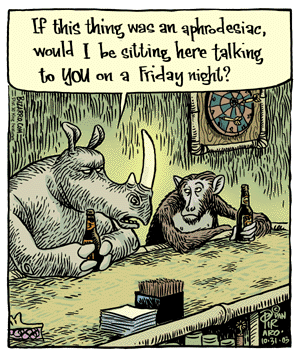
A good movie can make you both laugh and cry. Perhaps a good DawnWatch alert can do the same. The laugh, above, is today's (October 31) "Bizarro" comic. Creator Dan Piraro is a Genesis Award winner. Influenced by his wife, Ashley Lou Smith, he is a relatively new vegan and animal rights activist. For those whose computers do not display the cartoon: We see a rhinoceros, with a huge tusk, sitting at a bar next to a baboon. Both have beers. The rhino says, "If this thing was an aphrodisiac, would I be sitting here talking to you on a Friday night?" (Much thanks to fellow Genesis Awards committee member, Marjorie Loeb, who faxed me a copy of this so I knew to hunt it down to send out.) Piraro has done other wonderful animal rights themed comics. (One of my favorites has a lab animal in a cage saying to a vivisector "Hey Einstein -- how about working on a cure for insensitivity to other species?") You can learn more about his work at: http://www.bizarro.com/. He tells me he is working on some animal rights pages for his website that will be up in a few weeks. I will keep you posted. Sadly (here come the tears), Piraro's animal rights jokes have too much truth, and this one is terribly timely. A front page Washington Post story on October 11, by Shakar Vedantam, told us: "The Bush administration is proposing far-reaching changes to conservation policies that would allow hunters, circuses and the pet industry to kill, capture and import animals on the brink of extinction in other countries." You can read the whole article, headed, "U.S. may expand access to endangered species" at: http://www.washingtonpost.com/ac2/wp-dyn/A10660-2003Oct10?language=printer The Post takes letters at: letters@washpost.com The Society
for Animal Protective Legislation website has an action alert on the issue,
which details the likely effects of the regulation change. It is at: http://www.saplonline.org/Alerts/103103.htm
It notes
that comments are due by November 10 and asks us to write to the U.S.
Fish and Wildlife Service / Division of Conservation and Classification to tell
them that we oppose the proposed rule. The address is: Division of
Conservation and Classification U.S. Fish and
Wildlife Service Arlington Square
Building 4401 N. Fairfax
Drive, Suite 420 Arlington, VA
22203 Fax:
703-358-1735. The alert continues: "Also, please call both of your United States Senators and your Congressional Representative and urge them all to contact the Fish and Wildlife Service in opposition to this change in regulation! You can reach any of these legislators through the Capitol Switchboard: 202-224-3121." And finally: "Encourage others to do the same. Spread this message wherever you can." Today's blessed Bizarro comic strip, appearing in newspapers across the nation, gives us a wonderful opportunity to spread the message. We can write letters to the editor noting that the comic deals with a serious issue, and urging readers to contact the Fish and Wildlife Service and their senators. If you have any trouble locating the correct email address for a letter to the editor of your paper, don't hesitate to ask me for help. Always include your full name, address, and daytime phone number when sending a letter to the editor. Shorter letters are more likely to be published.
USA TODAY ON SARS GIVES GRAPHIC DESCRIPTIONS OF ANIMAL CRUELTY 10/29/03 USA Today,
Wednesday October 29, has a large article, with distressing photographs, on the
front page of the World section (p.13A)
HUMANE EDUCATION SCHOOL IN CALIFORNIA - SLAMMED BY SAUNDERS 10/26/03 Columnist Debra Saunders is fast becoming one of those convenient people you can use as a litmus test: if she has a beef with you, you know you must be doing something right. So I noted with delight that she had another anti animal rights column in the Sunday, October 26, San Francisco Chronicle (p. D4). Indeed, the news is good. The column is headed "Vegan Elementary." Her complaint is that Sacramento's San Juan Unified School District has approved a K-6 charter school to be called the Humane Education Learning Community. Saunders quotes the charter petition: "People who are trained to extend justice, kindness and mercy to animals become more just, kind and considerate in their relations with each other." The comments, in parentheses, "Note that they're not more just with other people, which is why some animal rights nuts feel free to bomb buildings and intimidate workers remotely connected to medical research that uses animals." Kind of her to write "some" since in a movement of at least hundreds of thousands of people, we have seen two bombings on behalf of the cause (done in the middle of the night to avoid harm to humans) and a tiny proportion of us are involved in intimidation of researchers. Her comment points to the quandary of such actions -- they often bring media where there was silence, and the intimidation can be effective, but they are bad for the movement's compassionate image. However, Saunders is hardly an unbiased member of the public or media being turned off by such activity -- she is vehemently pro animal research and anti animal rights. She is unlikely to change her position if we play nice. In fact, what could be nicer than humane education, which in this column, she attacks with full force. Saunders notes that the charter promises "respect for humans, all species and the environment," and "the promotion of harmonious relations, kindness toward domestic pets and humane treatment of living creatures." She adds that the charter model will "replace discipline based on rewards and punishments with one based on respect, responsibility and reverence." Sounds terrible
doesn't it? She ends with: "If I were to write a parody of something an animal nut/educrat would create, I would have written this document. The difference is: I would never inflict it upon innocent children. I'd know it was a joke." And I find myself smiling at the end of Saunders' deliciously predictable rant. You can read the whole, rather fun piece at the Town Hall website: http://www.townhall.com/columnists/debrasaunders/ds20031027.shtml The article gives Saunders' email address but those tempted to write her nasty notes (and it could be quite tempting) might ask themselves if that will help the animals. Far better, I think, to be grateful that she took on this topic, since she has provided an opportunity for us to write pro-veggie letters to the editor. They might be read by those with minds more open than hers. The San Francisco Chronicle takes letters at: letters@sfchronicle.com and notes "Please limit your letters to 200 or fewer words ... shorter letters have a better chance of being selected for publication." Always include your full name, address, and daytime phone number when sending a letter to the editor.
ANIMAL RIGHTS WRITER AND NOBEL PRIZE WINNER -- J.M. COETZEE 2003 J.M. Coetzee won the Nobel Prize in Literature this month. Due to the prize, his latest novel has been getting a lot of attention. The timing is fortuitous since the new novel, 'Elizabeth Costello', deals seriously and extensively with animal rights issues. It is the cover review (printed on pages 15&16) in the Sunday, October 26, New York Times Book Review. The new book is less a novel than a series of lectures or lessons, tied together in that they are delivered by the same fictional author. The author seems to be a female alter-ego of Coetzee. She shares characteristics for which he is known: she is around his age, lives in Australia, is somewhat socially awkward, and uncomfortable with the glitter of academic celebrity to the point of declining invitations to events at which she has been awarded the most prestigious literary prizes. And given how extensively she lays out her views on social issues, such as animal rights, I presume she shares them with her creator. Coetzee is vegetarian. Two of the eight lessons are on animals rights. I am delighted that the New York Times review is favorable -- some other reviews were not raves. Some reviewers have not enjoyed the format. They have recommended readers pick up, instead or first, one of Coetzee's other more accessable novels, such as "Disgrace." I fell in love with the prickly character of Elizababeth Costello and found myself longing for much more intimate time with her, and less of her lectures. So I will surely pick up other books by Coetzee in the hope of getting to know some of his characters better. But I was saddened to see some reviews guide people away from 'Elizabeth Costello' since his other works do not examine, to anything like the same extent, the issue of animal rights. (Though Disgrace makes the connection between compassion for people and for dogs.) The exception is The Lives of Animals, which I read when it came out in 1999. The two animal rights lessons in Elizabeth Costello are reprints of the lessons that make up The Lives of Animals (which were originally delivered as lectures by Coetzee at Princeton University). But like 'Elizabeth Costello,' it is a series of lessons more than a novel. It looks at the issue of animal rights even more extensively since it includes chapters in response by Marjorie Garber, Peter Singer, Wendy Doniger, and Barbara Smuts. Those responses illuminate just how radical Elizabeth Costello's positions are. Peter Singer, accused by those outside our movement as putting human and nonhuman life on the same plane, only accepts Costello's holocaust comparison as long as it is a comparison and not an equation. He writes, "There is a more radical egalitarianism about humans and animals running through her lecture than I would be prepared to defend." Costello rejects, and we can assume that Coetzee therefore at least questions, the notion that human thought processes give more value to our lives than than the lives of other species. Singer, however, picking up Costello's reference to the death of a bat, draws an analogy between emptying a bottle of soy milk, as opposed to Kalua, down the sink. He writes, "The value that is lost when something is emptied depends on what was there when it was full, and there is more to human existence than there is to bat existence." If we could speak bat, and were to ask one her opinion, I bet she'd side with Costello. As Milan Kundera writes in 'The Unbearable Lightness of Being' (p. 286): "The very beginning of Genesis tells us that God created man in order to give him dominion over fish and fowl and all creatures. Of course, Genesis was written by a man, not a horse." (As I go on to read the rest of that paragraph I am amused to realize that another of Costello's arguments, suggesting that man invented God-given dominion to excuse his own abuse of animals, had been presented by Kundera in my favorite novel of all time in 1985. I had forgotten.) The holocaust analogy drawn by Costello is strong. Earlier this year, when reporting on a Los Angeles Times op-ed by Stephen Dujack in response to PETA's "Holocaust on your Plate" campaign ( http://www.MassKilling.com) I noted that I found one of his arguments particularly compelling. (Again) I had forgotten that I had previously read it -- in The Lives of Animals. It has been argued that one reason one cannot compare the deaths in the Holocaust to deaths in slaughterhouses is that there is a purpose, other than murder, for those deaths: the animals are to be eaten and/or worn. Costello (and Dujack in the op-ed) notes that the making of pillows or lamp-shades from human hair and skin does not lessen the horror of the holocaust and should not negate the horror of the mass slaughter of animals. The 'Elizabeth Costello' New York Times review, by Judith Shulevitz, is headed, 'Author Tour.' You can read it on line at: http://www.nytimes.com/2003/10/26/books/review/26SHULEVT.html I always encourage taking any excuse for animal friendly letters to the editor. This review provides a decent one. The Times takes letters at: letters@nytimes.com Always include your full name, address, and telephone number when writing a letter to the editor. I am selling Coetzee's 'Elizabeth Costello' and 'The Lives of Animals', via Amazon, from my website under Recommended Reading. (You pay no more and I get a small commission I give to animal advocacy groups.) The Nobel Prize winner's latest novel, 'Elizabeth Costello,' would make a great holiday gift for any literary friends or family members in whom you'd like to encourage some reflection on animal rights issues. If you are interested only in the animal rights arguments and less in the other lessons or Costello's character, and if you would also like to have the response chapters noted above, buy 'The Lives of Animals' instead. Since it is in paperback, it is cheaper. Having discussed Costello's holocaust analogies, I will also recommend Charles Patterson's book "Eternal Treblinka," probably the most thorough discussion of this issue to be published to date. It has been very well reviewed, even by religious Jewish groups. I found it compelling.
FOIE_GRAS CONTROVERSY FILLS CALIFORNIA MEDIA 10/22/03 California media
has continued to cover the foie gras controversy this week. The Bay Area ABC
affiliate, Channel 7, which originally aired a story on September 16, following
the restaurant vandalism, aired a follow up report on Wednesday, October 22. It
covered lawsuits, countering each other, filed by foie gras producers and
activists. The coverage came across as balanced, but included plenty of foie
gras footage, so was helpful to our cause. An image I found particularly
shocking was that of a duck liver intentionally bloated to make foie gras,
displayed next to a normal duck liver. I cannot imagine the pain from a liver
that size in an animal the size of a duck. You can view the Wednesday night
story, and read some of the text, on line at: Always include
your full name, address, and daytime phone number when sending a letter to the
editor. Shorter letters are more likely to be published.
WALL STREET JOURNAL ON VEGETARIAN BUILDINGS IN BOMBAY 10/22/03 There is a fascinating article on the front page of the Wednesday, October 22, Wall Street Journal (America's second largest newspaper) headed "Carnivore Control: The Unwritten Rule In Bombay Real Estate." It is sub-headed: "More Landlords Are Saying,No Meat Eaters, Please; 'People Want Pure Veg'" The story is by Journal reporter Joanna Slater. Slater opens with the rejection of a potential buyer from a Bombay apartment building because he eats meat. She explains: "A number of buildings, old and new, in the wealthiest precincts of this teeming city of more than 12 million are going vegetarian and are enforcing an unofficial ban on meat eaters. Since cows are sacred to Hindus, most of India's billion citizens don't eat beef, but this is far from a nation of vegetarians. Mutton, chicken and fish are eaten in many parts of India. Here in Bombay, on the west coast, seafood is a favorite, particularly a pungent dried fish whimsically known as Bombay Duck." But she writes "there is also a small-but-influential minority of strict vegetarians" many of whom are property developers. She notes that India has about 3.4 million Jains, the most observant of whom don't eat meat or eggs. Slater includes includes quotes from people living in the vegetarian buildings who can't stand the smell of meat. She notes that making a building strictly vegetarian can be a good business move since "Vegetarians are often willing to pay a premium for an environment in harmony with their religious beliefs and no-meat lifestyle." She continues, "Take India's tallest building, a brand-new 45-story skyscraper called Shreepati Arcade in the heart of Bombay. It, too, has a distinct preference for vegetarian tenants." I suspect many Americans reading this article will judge the practice intolerant. Yet it is common practice for New York co-op buildings to exclude rock stars or others likely to have wild parties. Is the preference for the straight-laced to avoid the smell of burning weed more valid than that of vegetarians to avoid the smell of burning flesh? Perhaps some Wall Street Journal readers will be inspired and see a good business opportunity here. One immediately thinks of San Francisco as a city where a strictly vegetarian building could attract people willing to pay premium prices. This front page story presents a great opportunity for supportive letters to the editor. You can read the story on line at: http://online.wsj.com/article_email/0,,SB106677467828095200-H9jeoNilaV2o52mZoGIaqeIm4,00.html The Wall Street Journal takes letters at: wsj.ltrs@wsj.com
Always include your full name, address, and daytime phone number when sending a letter to the editor. Shorter letters are more likely to be published.
USA TODAY ON NEW HUMANE STANDARDS FOR WHOLEFOODS 10/21/03 There is a great
little article on the front page of the Money section (pg 1B) in the
Tuesday, October 21 edition of USA Today, headed, "Whole Foods pledges to
be more humane. New animal standards will be a first for grocery chains." Reporter Bruce Horovitz opens with: "Whole Foods Market today will announce plans to become the first major grocery chain to adopt humane animal treatment standards. The move follows nearly two years of intense pressure from two animal rights groups that have previously persuaded the fast-food giants -- from McDonald's to Burger King -- to improve standards. It also comes at a time when consumer interest in animal rights issues has ramped up nationally. An overwhelming 96% of Americans say animals deserve 'some' protection from harm and exploitation, according to a recent Gallup poll. The natural foods retailer, known for its organic offerings, will allow an independent third party to be named to audit its changes. "The plan gives activists added leverage to continue pushing Safeway and Kroger on animal welfare standards -- and it relieves Whole Foods of potential image problems that might have miffed its mostly upscale audience. "But John Mackey, CEO of the grocery chain, insists the move wasn't motivate by a desire to be politically correct -- nor was it the result of outside pressure. Mackey is quoted: "Whole Foods does not respond to coercion. We re-examined (activists') claims and decided they were basically right." It is standard for corporations to deny that pressure tactics had an effect -- McDonald's said the same thing when bringing in welfare standards after years of pressure from PETA and others. However, Mackey, who went vegetarian years ago and recently vegan (after reading Animal Liberation and other books) has considerably more credibility. A quote from him in this piece reinforces that credibility: "I came across an argument I could not refuse: Eating animals causes pain and suffering to the animals." Nevertheless, one is reminded of chef Tracy Des Jardins, in San Francisco, who said her choice to drop foie gras from her menu was due to her being haunted by images of ducks she saw on a foie gras farm in 1995. But she took it off the menu eight years later, only when the recent spate of anti-foie gras vandalism broke out in San Francisco. It seems "good cop/bad cop" tactics work. There is a good quote from Viva's Lauren Ornelas (http://www.vivausa.org) who has been a leading influential "good cop" in this matter: "It's a big deal for the animals.... Whole Foods customers don't like the idea of ducks whose bills are cut off." You can read the whole article on line at: http://www.usatoday.com/money/industries/food/2003-10-21-wholefood_x.htm This is a welfare, rather than rights issue, and I know there are those in our movement who see such moves as counterproductive. They feel such publicity will just make people feel better about eating the products of what is still immense animal suffering. That argument is not without merit; I know before I went vegan, I bought organic eggs for years, mistakenly thinking they were cruelty free. I did not know that organic, free range and humane certified labels are terribly misleading (check out http://www.eggscam.com) and that organic egg-laying chickens eventually end up as organic chicken pot pie. However, the world will not be vegetarian tomorrow. It is reasonable to assume that the animals suffering today would want us to do everything we can to relieve some of their suffering, while continuing to assert that in a world where over 6 billion people must be fed, a diet including animal products cannot be cruelty free, and that a plant based diet is a healthful, and the only ethical, choice. We can make that clear with letters to the editor. USA Today takes letters at: editor@usatoday.com Always include your full name, address, and daytime phone number when sending a letter to the editor. Shorter letters are more likely to be published.
ANTI FOIE GRAS OP-ED IN SAN FRANCISCO CHRONICLE 10/19/03 On Sunday, October 19, the San Francisco Chronicle ran an op-ed by Byran Pease headed, "A demand for haute cusine is no excuse to condone animal cruelty." (Pg D5.) Pease opens: "
When a California foie gras producer came under scrutiny last month for
force-feeding ducks to enlarge their livers to 12 times their natural size,
Sonoma Foie Gras made claims to the media that the ducks are "not force
fed" and that they are "free range." The Animal Protection and
Rescue League went inside the company's Stockton farm as well as that of the
only other foie gras farm in the United States to document that both places
force large metal pipes down the throats of these birds two to three times a
day, and pneumatically pump into them grain equaling one-tenth of a healthy
duck's body weight per feeding. "APRL also
videotaped ducks too weak to stand up, ducks suffering from anal hemorrhaging
from the force-feeding, piles of dead ducks, and even a rat gnawing the wounds
of ducks too weak to defend themselves at Sonoma Foie Gras. Ducks at Hudson
Valley Foie Gras in New York, the only other U.S. producer, are kept in cages so
small they cannot lift a wing or turn around." He goes on to
explain that "foie gras" or fatty liver, is a disease, and to
recommend that the United States follow the lead of other countries, most
recently Israel, and ban force-feeding. You can read the
whole op-ed on line at: http://www.sfgate.com/cgi-bin/article.cgi?file=/chronicle/archive/2003/10/19/EDGM82D1QS1.DTL It gives us a good opportunity for veg-friendly letters to the editor. The San Francisco Chronicle takes letters at: letters@sfchronicle.com Always include your full name, address, and daytime phone number when sending a letter to the editor. Shorter letters are more likely to be published.
FRONT PAGE STORY ON MINK RELEASE -- WASHINGTON POST 10/18/03 The Saturday,
October 18, Washington Post front page carried a story headed, "The Fur
Flies and Crawls and Bites; Minks Released by Activists Raise a Stink Near
Seattle."
KATU TV NEWS REPORT ON TRAPPING INCLUDES EXTENSIVE GRAPHIC FOOTAGE 10/17/03 On Friday, October 17, KATU TV in Portland Oregon aired a story on the need for legal limits on the time animals can spend in traps. The report was extraordinary for the graphic footage included. Horrifying images of animals caught in traps was aired, with extensive commentary from HSUS's Wayne Pacelle. One of Pacelle's comments compared being caught in a leg-hold trap to having a hand slammed in a car door, but rather than having it immediately released, staying that way for days. You can view the whole report on line at: http://www.katu.com/news/story.asp?ID=61670 The written report on that page is a very abbreviated version of the coverage, so watch the video if you can. Please thank KATU for the report! The station takes comments at: http://www.katu2.com/cgi-bin/2003/mail/main_form.cfm
LOS ANGELES TIMES FRONT PAGE ON DOLPHIN CAPTIVITY 10/17/03 The controversy over dolphin capture and captivity has made the front page of the Friday, October 17, Los Angeles Times. The lengthy article by Richard C. Paddock and Richard Boudreaux is headed, "Any Way to Treat a Dolphin?; The brainy animals' tourist appeal has led to relocation, confinement and, some say, trauma. But Solomon Islanders who hunt them see cash." It opens:
The article discusses the recent sale of 28 dolphins to Parque Nizuc in Mexico for swim with dolphin programs. The dolphins' arrival is described:
The article explains that though catching dolphins for export is new to the Solomon Islands, dolphin hunting is not: "The
annual dolphin hunt is part of a Solomon Islands tradition that is at least 500
years old. The hunt, essential for both money and marriage, follows strict
rules. Most of the hunters, all of whom are men, live in seven villages on the
island of Malaita. They must purify themselves for at least a month before the
hunt by living in a special house away from their village and having no contact
with women. The article discusses the men behind the Solomon Islands captures and the political state in that area. It ends with an argument that many animal advocates will support: "In Honiara, the men who helped catch the dolphins protest that the Solomon Islands is being held to a different standard from other countries. What is the difference, they say, between keeping dolphins in a pen in the Solomon Islands and keeping elephants in a zoo in America?" The piece ends with the following quote from Satu's son: "If we have to let them go, tell the rest of the world to let all their animals go. Make it fair." Alright! This front page article gives us a great opportunity for appreciative letters to editor arguing against keeping any animals in captivity for human entertainment. You can read the whole article on line at: http://www.latimes.com/news/nationworld/world/la-fg-dolphins17oct17,1,1673188.story The Los Angeles Times takes letters at: letters@latimes.com Always
include your full name, address, and daytime phone number when sending a letter
to the editor. Shorter letters are more likely to be published.
TIME MAGAZINE ON DIET, PETS AND CAPTIVE TIGERS 10/20/03 There are three
articles in the current, October 20, edition of Time Magazine that should be
addressed by animal advocates.
SEATTLE TIMES ANTI-VIVISECTION OP-ED 10/14/05 The Northwest Animal Rights Network (http://www.NARN.org) has been active this week, opposing the American Association for Lab Animal Science, which is currently hosting a conference in Seattle, attended by approximately 4,000 vivisectors. NARN has made much press, including a terrific op-ed in the Tuesday, October 14, Seattle Times headed "Animals needn't die to save human lives." The op-ed is by veterinarian Dr Andrew Knight, NARN's new Director of Research and Education. Knight opens with a poignant description of the vivisection of a healthy pig when he was in vet school. He writes, "One other student and I refused to be party to this killing. Our reward was the scorn and derision of some of our esteemed professors and classmates, who told us that surgery could be learned in no other way. Yet, we persisted, finding homeless dogs and cats from animal shelters and helping sterilize them to ensure fewer unwanted puppies and kittens would be born. We succeeded, ending up with five times the surgical experience of our classmates who killed to obtain their degrees. "The leaders of the American Association for Laboratory Animal Science (AALAS), who are hosting the largest gathering of animal experimenters in the world at the Washington State Convention & Trade Center this week, would have us similarly believe that human lives can be saved in no other way. Regrettable though it is, animals must die, they tell us, in order to find cures for devastating diseases such as cancer, diabetes, heart disease and stroke. Yet, is this in fact true?" He notes that the "war on cancer," having animal testing at its core, has been a "qualified failure", whereas preventative medicine, which would save millions of lives, has been largely ignored. And we learn that "adverse reactions to drugs deemed safe after passing animal tests are the fourth-leading killer of Americans, killing more people each year than all illegal drugs combined." It is a terrific op-ed, which can be read in full at: http://seattletimes.nwsource.com/html/opinion/2001765080_animals14.html It provides a great opportunity for supportive letters to the editor. The Seattle Times takes letters at: opinion@seattletimes.com
Always include your full name, address, and daytime phone number when sending a letter to the editor. Shorter letters are more likely to be published.
WASHINGTON POST ON ADOPTING AND OLDER DOG 10/14/05 The Tuesday,
October 14, Washington Post has a particularly lovely article, by Susan Lennon
headed: "Adoption: For Old Dogs, A New Leash on Life." (Pg C10)
AUSTRALIA'S SHIP OF DEATH ON LA TIMES FRONT PAGE 10/12/05 Two weeks ago I
sent out an alert about a disastrous situation that had been making news in
Australia and around the world, but not in America. Finally, the Sunday, October
12, Los Angeles Times, carried the story on the front page : "A Shipload of
Sheep Without a Harbor." It is also in the Monday, October 13, Chicago
Tribune, Vancouver Sun and San Francisco Chronicle
(details below). After it had been ignored in the American press for too long, it was heartening to see this story on the front page of the Los Angeles Times and in other American newspapers. It presents a good opportunity for appreciative letters to the editor. Letters might point out that this Australian incident could hardly be considered unusual cruelty in the food industry. All animals considered to be livestock are exempt in the USA from the Animal Welfare Act. An excellent source of information on the egregious cruelty endured by animals raised for food in the United States is the website: http://www.FactoryFarming.com You can read the
whole Los Angeles Times article on line at: http://www.latimes.com/news/printedition/la-fg-sheep12oct12001430,1,3364233.story or on the San Francisco Chronicle website at: http://www.sfgate.com/cgi-bin/article.cgi?file=/c/a/2003/10/13/MN188784.DTL According to the website, it appeared on page A2 of the the Monday, October 13 Chronicle. A shortened
version of the same article appeared in the Monday, October 13, Chicago Tribune
(pg 4; Zone: CN), headed, "Rumor of illness keeps sheep adrift as ports
deny entry; Animals dying on ship after sale fails." It appeared the
same day in the Vancouver Sun (page A.8) headed, "Sheep
'death ship' wanders the sea: Australia can't even give away animals after Saudi
Arabia claimed they were ill." The Los Angeles Times takes letters at: letters@latimes.com The San Francisco Chronicle takes letters at: letters@sfchronicle.com The Chicago Tribune takes letters at: ctc-TribLetter@Tribune.com or http://www.chicagotribune.com/news/opinion/letters/chi-lettertotheeditor.customform The Vancouver Sun takes letters at: sunletters@pacpress.southam.ca Always include your full name, address, and daytime phone number when sending a letter to the editor. Shorter letters are more likely to be published.
FRONT PAGE STORIES ON AR BOMBING SUSPECTS 10/10/03 Animal rights is
back on the front page. The front pages of the Friday, October 10, San Francisco
Chronicle, San Jose Mercury News, and Los Angeles Times Metro section all carry
the FBI's naming of a suspect in the recent bombings of Chiron and Shaklee
corps in California. The Contra Costa Times has the story on page F4. The Contra Costa
Times article, by Scott Marshall is headed "Suspect named in Bay Area
bombings" and offers similar information.
MALIBU TIMES ON TIMOTHY TREADWELL 10/08/03 The Malibu Times has a nice lead story about, and photo of, Tim Treadwell. In contrast to the Associated Press piece which tried to portray him as a bit of a fool, his home town paper makes it clear that he was aware of the dangers he faced but was willing to take the risk. You can read it on line at: http://www.malibutimes.com/articles/2003/10/08/news/news1.txt The Malibu Times takes letters at: Malibunews@malibutimes.com
ATLANTIC MONTHLY AND TIME MAGAZINE ON CHIMPS IN ENTERTAINMENT BUSINESS 10/13/03 The current, October 13, Time Magazine has a short but importance piece on a call to end the use of chimps as comic actors. It coincides with a touching article in this month's Atlantic Monthly about a chimp named Oliver who went from actor to laboratory research subject. The Time Magazine piece is headed, "Cheetah, You Ought To Be Out Of Pictures." (Pg. 24) It is very short, so I will share the whole piece, also available on the web at: http://www.time.com/time/magazine/article/0,9171,1101031013-493291,00.html Margot Roosevelt writes: "They smoke cigars, swing from chandeliers and look cute on roller skates. Ever since Tarzan, chimpanzees have been reliable comic relief in movies, TV shows and, lately, commercials for the likes of Capital One and Dr Pepper. But now a coalition of activists headed by Jane Goodall, the renowned ethologist, wants to force the apes into retirement. Goodall is linking up with the Chimpanzee Collaboratory, a consortium of eight primate-welfare and -conservation groups, to launch a broad effort to persuade Hollywood to ban the use of actor-apes. "Chimps, humans' closest living relatives, are 'capable of thoughts and emotions similar to our own,' says Goodall. 'The time has come to move beyond the misuse of creatures who are vulnerable to our exploitation precisely because they are so like us.' To be turned into actors, the Collaboratory claims, chimps are removed as infants from their mothers and physically and mentally abused. The consortium will release a report and testimony by researcher Sarah Baeckler, who says she worked undercover for 1,000 hours at a Malibu, Calif., facility that trains chimps for Hollywood. Trainers, she says, repeatedly kicked, punched and beat chimps with hammers to make them obedient. Nonsense, says Sid Yost, owner of Amazing Animal Actors, which rents out chimps for TV productions. His chimps, he says, are 'affection trained' and 'live like at the Ritz-Carlton.' And they probably look great in tuxedos. --By Margot Roosevelt" You can read the wonderfully informative letter Jane Goodall wrote against the use of Chimps in advertisements at: http://www.peta.org/feat/greatapes/jgoodall.html The current, October 2003, Atlantic Monthly (pg. 94) has a sad story about a chimp named Oliver. He was a celebrity in the 1970's and 80's but ended up in a research lab where he lived for seven years in the 90's. He now lives at Primarily Primates. One paragraph of the article is particularly relevant to the Time Magazine piece and the quest to get chimps out of the entertainment business. The writer, James Shreeve, discusses Oliver's role in a Dick Clark TV show, starring opposite Loretta Swit. Then he writes, "This was the mid-1980s and Oliver was well into his twenties; it is a wonder that he was still tractable enough to be worked with at all. A performing chimp's career is usually over by around the age of eight, though a trainer may be able to safely squeeze out a couple more years by pulling the animal's front teeth or, in the case of a male, by castration. Since chimps in captivity can live forty or even fifty years, the question arises of what to do with all those movie and circus veterans for the remaining 80 percent of their lives. Some are used to breed the next crop of performers; others end up in private homes or roadside zoos; and many, like Oliver, are sent to bio-medical research labs...." Unfortunately, the article is not available on line. (I thank Alex Otto for making sure we knew about it.) But I recommend picking up the magazine to read it. It is written with much tenderness. The November issue is scheduled to appear on stands on October 14, so you only have till then. Both of these articles present great opportunities for appreciative letters to the editor supporting a ban on the use of chimps in advertising, and elsewhere, for human profit. Time Magazine takes letters at: letters@time.com The Atlantic Monthly takes letters at: http://www.theatlantic.com/letters/edlet.htm or you can send letters straight to letters@theatlantic.com, including your name, address, and telephone number.
VETERINARY COLLEGE THAT SHUNS VIVISECTION 10/7/03 The Tuesday, October 7, Los Angeles Times, has an inspiring article, by Steve Hymon, headed: "'No Harm' Approach to Medicine; Students at a new veterinary college are learning their profession by practicing on animals that have died naturally." (Part 2, Page 3) We learn: "At many schools, it's common practice to buy live dogs and cats from pounds or biomedical firms, then have students operate on them and later euthanize them. But these kinds of surgeries won't occur at Western, which has pledged to use donated animals only -- those that have already died of natural causes or been put to sleep because of illness or old age." We hear about the school's other "distinctive touches": "Several days before the students began dissecting their dogs, for example, a ceremony was held in which the dogs' owners told students about their deceased pets' lives, even showing them videos." Naturally,Jack Walther, president of the American Veterinary Medical Assn, a distressingly backward organization that opposes much animal friendly legislation, has some ungenerous words for the program "From my own personal perspective, there is a certain necessity to doing some procedures on a warm body, if you will. It's just the reality of learning medicine." But many vets support it.
I know quite a
few animal people are turned off vet school by the idea of vivisection and
killing. I send out this article to spread the word that there is now another
option in this country, hopefully one that will spread. You can
read the whole piece on line at: http://www.latimes.com/news/local/la-me-vet7oct07,1,2838634.story?coll=la-headlines-california You can
send a supportive letter to the Los Angeles Times at: letters@latimes.com
Always include your full name, address, and daytime phone number when sending a letter to the editor. Shorter letters are more likely to be published.
SIEGFRIED AND ROY TIGER ATTACK 10/3/03 The attack on Roy Horn, of the famous Siegfried and Roy team, on Friday, October 3, has been all over the news. There does not seem to be a newspaper or news station in America that has not given much attention, often front page attention, to the attack. Newspapers around the world have also shown much interest. Until last night, however, it was hard to find a story that focused on anything other than the event and Horn's unfortunate condition. But now we are starting to see some focus on the sorry state of tigers in this country and the ethics of keeping wild animals in captivity. Below, I will note some coverage of the bigger picture: A story on ABC World News Tonight, a wonderful New York Times editorial, a Chicago Tribune op-ed, a Philadelphia Inquirer front page story, a story in the Detroit Free Press, a New York Newsday story covering PETA's letter to Roy Horn, and some delightful words of wisdom from a nationally syndicated shock jock. I will provide links to the stories and for letters to the editor. However, assuming you have come across the Siegfried and Roy story in your own paper, and that the issue of wild animals in captivity was not touched upon, I hope you will consider, instead or as well, sending a letter to your paper mentioning the suffering of wild animals in captivity. (Feel free to ask me for help finding the correct email address.) You may want to mention the Exotic Pets Bill (discussed below) or the way animals suffer in most circuses. A good source for that information is: http://www.Circuses.com The Monday, October 6, ABC World News Tonight report on the incident stressed that tigers are wild animals, cannot be tamed, and "the best place for these animals is in nature, where they are originally found." The reporter noted that PETA would be addressing, with US Department of Agriculture, the danger not just to animals, but to people, of having wild animals on display. We have come to expect an animal friendly take from ABC World News Tonight, a multi Genesis Award winning program. But let's not take them for granted! When accepting her Genesis Award last year, one of the producers let us know that the wonderful feedback the show gets for animal friendly stories keeps those stories coming. Please thank the producers for taking a look at the whole issue of wild animal captivity. World News Tonight takes feedback at: http://www.abcnews.go.com/sections/wnt/WorldNewsTonight/WNT_newemail_form.html (And I thank superb East Coast activist Teresa D'amico for making sure I knew about this.) Nationally syndicated shock jock, Phil Hendrie, touched on the issue on his Monday, October 6 program, and said all the right things. I have transcribed a good chunk of his comments about Siegfried and Roy and performing animals: "They look like two nice guys doing their animal act. But I gotta tell you something, and this is just my own personal opinion. Wild animals are wild animals. A wild animal... you will never domesticate it. The best you can do is train it and I understand these two men are probably the best at what they do. But I don't like to see these kinds of acts -- they are not favorites of mine. I don't go to Sea World and I don't go to 'Aquarium-land.' I don't go to zoos. I don't like to see wild animals in captivity. It's not what I get a kick out of. I don't want to see the elephants going around holding onto each others' tails and I don't want to see the pandas rolling around. Why don't you just let these animals live where they live? But it is the ultimate conceit of man to continue down through the ages to try to prove that he can control nature at every level. Of course we can! We can go into the forest tomorrow and murder every wild tiger there is. Boom! We are better than them. Now do you feel good?" He notes that many circuses (not including Siegfried and Roy) drug their animals. Then he moves on to Sea World: "Who wants to go down to Seaworld and look at this poor animal, this poor Shamu, sitting in a tank all day long, bobbing up and down. And then for a few minutes he gets to run around in a tank bouncing balls off of his nose. That's exactly what whales do out in the Pacific by the way -- didn't you know that? They sit and bob up and down for about eight hours a day. Then they run around in a circle, then they just stay put. That's how they go from Alaska to Mexico. "Its unnatural. I can't stand it . It makes me want to break down and cry. " Please send Phil Hendrie a quick thank you. He deserves it! (And I send a big thank you to Bob Hayes for letting me know about it so that I could listen on line.) Tuesday, October 7, held a wonderful surprise in the The New York Times. On July 13, in the climate of human illness from prairie dogs, that paper ran an editorial against keeping any wild animals as pets, focusing on the plight of the animals. (Note: An editorial, as opposed to an op-ed, is the newspaper's official opinion, not one from a columnist or submitted by a reader or "expert.") Apparently that piece was not a fluke. The Siegfried and Roy incident, plus an attack by a tiger in a New York apartment the same week, inspired an editorial headed, "Tiger, Tiger" (October 7, pg A 26.) Here is the last paragraph of that editorial: "But the ultimate illusion onstage at the MGM Mirage and at Mr. Yates's apartment was always the illusion that these animals could be tamed, an image reinforced by innumerable publicity photos of Siegfried & Roy lounging with their animals. As Montecore and Ming have proved, tigers, like all big cats, remain wild under the skin, even if they have never lived in the wild. Big cats deserve better than to be kept as pets. There are as few as 5,000 tigers remaining in the wild, down from some 100,000 a century ago. Tigers have enough trouble as it is." You'll find the whole editorial on line at: http://www.nytimes.com/2003/10/07/opinion/07TUE4.html The Times takes letters at: letters@nytimes.com The Chicago Tribune ran an op-ed written by HSUS's Wayne Pacelle, headed "When puddy cats become 600-pound lethal weapons." (October 7, pg 21 zone C.) Pacelle describes the plight of the "nation's hottest exotic pets": "They often are imprisoned in tiny wire cages, tethered or chained in basements and barns, displayed outside gas stations and convenience stores to attract customers, used as guard animals by drug dealers or held in squalid, unaccredited roadside zoos....Tigers kept as pets or held in roadside zoos suffer from abuse, ignorance, poor diet, lack of veterinary care and painful physical ailments from random inbreeding." He also discusses the danger to humans, giving details of children who have lost limbs, or their lives, to pet tigers. He finishes with a push for legislation to restrict ownership of wild animals: "When one of
the best-trained and most experienced handlers of big cats, like Roy Horn of the
famed duo Siegfried & Roy, is attacked and dragged around like a rag doll,
it is plainly obvious that untrained private citizens should not keep big cats
as pets. This growing threat to the American public, the widespread abuse of
these animals and the patchwork of inadequate state and local exotic animal
laws, underscores the need for legislative action. Twenty states currently ban
ownership of big cats but 14 have no laws governing ownership and the remainder
have a confusing tangle of inadequate regulations. He is referring to the Exotic Pets Bill. You can find out more about it, and send a letter to your legislators in support of it at: http://action.fund.org/action/index.asp?step=2&item=1310 The full Chicago Tribune op-ed by Pacelle is on line at: http://www.chicagotribune.com/news/opinion/oped/chi-0310070128oct07,1,1274964.story The Chicago Tribune takes letters at: ctc-TribLetter@Tribune.com The
Philadelphia Inquirer has the story on the October 7 front page: "Alarms
raised over wild beasts as pets; Writers Joseph A. Gambardello and Faye Flam tell us: "Wild animals and their keepers have drawn increased scrutiny since Roy Horn of Siegfried and Roy was mauled by one of his tigers during a show in Las Vegas on Friday, and since a New York man was placed in custody in Philadelphia after police found a tiger and an alligator in his apartment in Harlem." Avery Bennett, chief veterinarian for the University of Pennsylvania veterinary school is quoted, "Unfortunately, the tigers get the blame and it's not their fault. Humans should not own tigers....It just takes one grumpy moment in the cat's life." And the Animal Protection Institute's Nicole Paquette is quoted: "Roy Horn has over 30 years of experience training animals and working with them. And he's not safe from attack. So who is?" You'll find the Inquirer story on line at: http://www.philly.com/mld/inquirer/6949314.htm The Philadelphia Inquirer takes letters at: inquirer.letters@phillynews.com The October 7 Detroit Free Press has an article by Joel Thurtell headed, "Zoo official: Wild animals not for show; He says acts and circuses suppress beasts' natures." The article quotes Scott Carter, director of conservation and animal welfare at the Royal Oak zoo: "These entertainment venues fail to provide what animals need, and they present animals in ways that don't foster an understanding or respect for the animals. And they provide some risk to the handler, and also there are cases of bystanders being injured in circuses when animals have escaped....We feel there should not be animals in circuses, and we believe the animal acts in other kinds of entertainment should not exist....It is a very real problem all over the United States. What happened in Las Vegas was a high-profile example of something that happens all over the country." The article is on line at: http://www.freep.com/news/locoak/tiger7_20031007.htm The Detroit Free Press takes letters at: letters@freepress.com New York
Newsday ran a story on a letter PETA has sent to Roy Horn: "PETA Roars Over
Roy Incident; You can read the article at: http://www.nynewsday.com/entertainment/nyc-etpeta3484426oct07,0,995768.story and the full
text of the letter at: http://www.peta.org/news/NewsItem.asp?id=2997 New York Newsday takes letters at: http://cf.newsday.com/newsdayemail/email.cfm America's most widely distributed newspaper, USA Today, has not looked, so far, at the bigger issues around the attack. I hope we can
redress that lapse with letters to the editor. Here is a link to the paper's
October 7 story, "Anxious fans pray for mauled entertainer 'Siegfried &
Roy' show's staff told to look for jobs. " (Page 3A): The paper takes letters at: editor@USAToday.com No doubt,
as Horn remains in hospital, the attack will continue to make news. Please
respond, whenever you can, with letters to the editor against keeping wild
animals in captivity. Always include your full name, address, and daytime phone number when sending a letter to the editor. Shorter letters are more likely to be published.
CHICAGO TRIBUNE HUGE SPREAD ON VEGETARIANISM 10/5/03 The Magazine section of the Sunday, October 5, Chicago Tribune has a huge spread on vegetarianism. The spread includes: The introduction to the Magazine's focus on vegetarianism: http://www.chicagotribune.com/features/health/chi-0310050520oct05,1,5865881.story A lengthy article headed "The Meatless Wonders," which looks at the change in vegetarian food over the last few decades, points to how delicious some of the current choices are, and explores reasons for choosing or shunning vegetarianism: http://www.chicagotribune.com/features/health/chi-0310050525oct05,1,159653.story "Confessions of a Carnivore," an odd and unfortunate article by a man who abandoned meat nineteen years ago after picking up a copy of Animal Liberation, but has just started eating it again. http://www.chicagotribune.com/features/health/chi-0310050524oct05,1,7700893.story And
"Pass the vegetables, please! A tour of five regular restaurants where
eating vegetarian could really grow on you": Please take this wonderful opportunity to write a veg-friendly letter to the Chicago Tribune. The Tribune takes letters at: ctc-TribLetter@Tribune.com or http://www.chicagotribune.com/news/opinion/letters/chi-lettertotheeditor.customform Always include your full name, address, and daytime phone number when sending a letter to the editor. Shorter letters are more likely to be published.
ANIMAL RIGHTS EXPLOSIONS BACK ON FRONT PAGE 10/2/03 Animal rights activism has made the front page again. A Thursday, October 2, San Jose Mercury News front page headline reads, "Ecoterror attacks more frequent and fierce; Bay Area Bombings Among Recent Wave Across US." Dana Hull opens with: "The term 'domestic terrorism' often conjures up images of right-wing militias, Timothy McVeigh and anti-abortion activists bombing clinics and killing doctors. "But since 1977, the FBI has recorded nearly 1,000 criminal acts in the name of the environment or animal rights, and damages totaling $100 million. In recent months, the rhetoric has grown bolder and the attacks more destructive. "The recent bombings of Chiron Corp. in Emeryville and Shaklee in Pleasanton followed the torching of luxury homes and a condominium development in San Diego, and arson and vandalism of SUV dealerships in Los Angeles and Santa Cruz. Attacks that historically occurred in rural outposts are now happening in cities, and experts say it is just a matter of time before someone is killed." We read about the small cell structure of the Earth Liberation front and the Animal Liberation Front and about recent ELF activity. On animal rights activity: "In late August, two pipe bombs exploded outside of Chiron, a biotech firm....The latest incident happened Friday, when a homemade bomb exploded at Shaklee's offices in Pleasanton. The Revolutionary Cells Animal Liberation Brigade issued brazen communiques claiming responsibility for the Chiron and Shaklee bombings. FBI investigators believe the group is an offshoot of ALF." Hull writes: "While the attacks have drawn media attention that the perpetrators desire, more mainstream environmentalists and animal-rights activists doubt that the violent acts will persuade any company to stop animal testing or quench consumer thirst for luxury homes and Hummers." That line is ironic since ALF spokesperson disdain the media, whereas those criticizing the actions pursue media coverage. The article ends with a quote from HSUS's Wayne Pacelle: "Animal use is pervasive in society, and vandalism and bombings are not going to topple multimillion-dollar industries. A lot of these folks who are doing this are kids, and I understand their frustration. I just don't see where it gets you at the end of the day.'' Any comment he may have made as to what is behind the frustration, such as the institutionalized terror of animal testing, was not included in the article. We can address that omission with letters to the editor. Letters can denounce violent tactics (if that is the sender's position) but should focus on the cruelty issue -- the horror of the labs being protested and the unfortunate lack of interest shown by the press until there is destruction of property and a threat to humans. The companies where the bombs exploded have been targeted for their connection to Huntingdon Life Sciences, a notorious research lab. You can find out more about the campaign against HLS at: http://www.shac.net You can read the full article on line at: http://www.bayarea.com/mld/mercurynews/news/6913626.htm The San Jose Mercury News takes letters at: letters@sjmercury.com Always include your full name, address, and daytime phone number when sending a letter to the editor. Shorter letters are more likely to be published.
ANIMAL CAPTIVITY 10/1/03 The
suffering of other species held captive for human entertainment is making big
news this week. The Boston Globe has followed up the story of Little Joe with a
wonderful piece questioning the ethics of keeping gorillas in zoos. The New York
Times has a good piece on swim with dolphin programs as well as an article on
zoos. And the Philadelphia Inquirer has a front page story suggesting that wild
animals fare badly in zoos. That story is also in the Montreal Gazette.
|