|
ANIMAL MEDIA ALERTS -- JANUARY 2004
DECISION TO ABANDON CAMBRIDGE PRIMATE LABORATORY The big news in animal rights this week is Cambridge University's decision
to abandon controversial plans to build a primate laboratory, slated to
become the biggest primate center in Europe. The cost of running the laboratory,
particularly of protecting it from animal rights protestors, has been
cited in almost all of the UK papers as the reason for the decision.
LOS ANGELES TIMES LEAD ARTICLE ON FACTORY FARMING The Wednesday, January 21, Los Angeles Times has an excellent article on the cover of the Food section (pg F1), headed "The high price of cheap food." The commentary piece, by Times staff writer Emily Green discusses the down-side of factory farming -- how factory farming methods have led to mad cow disease, and also an over-abundance of cheap food and an obesity epidemic. It is a lengthy, informative article, perhaps best summed up in the following paragraph: "The drive for cheap food has gone beyond a brave experiment into a potentially catastrophic gamble. The stakes: the environment and public health. But none of the government officials charged with overseeing agriculture and environment is publicly suggesting the obvious fix: slowing down our intensive food production, treating the land and animals with more respect, producing less food, better food, more carefully." Though that paragraph mentions treating animals with more respect, the article does not focus on the treatment of animals. However, it opens the door for letters to the editor that do. Many people who do not eat animal products were moved to make the change when they learned about the cruelty of modern farming. We must, therefore, take every opportunity to educate the general public. A great source of information on factory farming is http://www.factoryfarming.com/ The site includes shocking photographs. You can read Green's full piece on line at: http://www.latimes.com/features/food/la-fo-meat21jan21,1,3197493.story?coll=la-headlines-food Letters appreciative of Emily Green's article, but which give more information on the suffering of factory farmed animals, can be sent to Always include your full name, address, and daytime phone number when sending a letter to the editor. Shorter letters are more likely to be published.
DATELINE ON PREMARIN CRUELTY The Dateline
story about Premarin aired Sunday January 18, and was excellent. It
covered the treatment of horses used in the production of the drug or discarded
by the industry and sent to slaughter. You can read the text on line at: http://msnbc.msn.com/id/3995076/ (Note: It
looks like you can actually view the TV segment on the website, but when
I clicked on the link it kept switching instead to IOWA caucus coverage.
Perhaps the glitch will get ironed out later.) One
of my favorite parts of the piece was a quote from actress Stockard Channing: "Everyone I have ever mentioned this to goes -- they say what are you talking about? It's not like, yeah, I heard about that. They literally don't know." Last night, Dateline made sure that millions more people know. And you can increase that number by making sure your friends or family members who might be taking Premarin see the story on the web. Please thank Dateline for spreading the word. Dateline takes comments at: Dateline@NBC.com
CHICAGO TRIBUNE -- FUR'S HOT AGAIN There is a dispiriting article on the front of the Style section of the Sunday, January 18, Chicago Tribune (pg Q1), headed, "Fur's hot again: The animal rights message has skipped a generation. Writer Wendy Navratil tells us that "the average age of fur buyers has dropped to 35 from 45" and "about 20 percent of buyers are under age 34." We learn that "at $1.7 billion in 2002, fur sales have climbed almost to the same record levels of the 'Wall Street'/'Dynasty' era." The lack of focus on this issue by animal rights activists is discussed. Activist and philosopher Tom Regan is quoted, noting that "those particular organizations whose primary focus was fur have just disappeared. And no one has stepped in to take up the slack." Unfortunately the article has quotes by those delighted with fur, such as this one from 26 year old Merritt Ames: "My grandmother used to wear this out and about in the '40s. Every time I wear it I get a ton of compliments and people asking where I got it. It's special. I'd love to give it to my daughter." And there is a quote from a model: "I don't even think of it as fur. The fashions are so trendy--the little boas, scarves." But there is no information on the cruelty of the industry. We learn, instead, that the fur industry has worked with the American Veterinary Medical Association to develop "the best methods of feeding and housing and managing disease and even euthanizing the animals." This is not surprising given the AVMA's general stance on animal welfare issues. It opposes most animal friendly legislation, such as bans on veal and sow crates. It won't even take a stand against forced molting -- the withholding of food and water from hens, for days, in order to shock them into a last round of laying. But unfortunately the average Chicago Tribune reader learning of the alliance will be under the impression that it points to humane treatment of fur-bearing animals. You'll
find the Chicago Tribune article at: http://www.chicagotribune.com/features/lifestyle/q/chi-0401180464jan18,1,1091114.story With letters to the editor, we can share the truth about the fur industry with Chicago Tribune readers. The PETA website http://www.furisdead.com/ has loads of information on the issue. If you click on "Campaign Center" you'll find links to horrifying footage. (Much more fun to watch is the delightful and informative Fund For Animals animated video, "There's a Fufanu in my collar too" at: http://www.fund.org/fur/pop_up_flash.asp ) The Chicago Tribune takes letters at: ctc-TribLetter@Tribune.com or http://www.chicagotribune.com/news/opinion/letters/chi-lettertotheeditor.customform Please put together a few lines in support of those who shun fur, or on the cruelty of the industry. And please be careful not to use any of my exact phrases from this alert in your letter, and never forward a media alert to activists, with a sample letter to the editor attached. Reams of letters from activists, clearly part of a campaign, are largely ignored by newspapers, whereas a few thoughtful lines will often be printed. Always include your full name, address, and daytime phone number when sending a letter to the editor. Shorter letters are more likely to be published.
TWO DENVER
EDITORIALS OPPOSING CIRCUS BAN As a sign
of the paradigm shift, our society's changing attitude regarding
the appropriate treatment of other species, we see another large city
attempting to ban circuses that use captive exotic animals. (You'll find
a list of those with bans already in place at http://www.api4animals.org/632.htm )
The Tuesday, January 13, Rocky Mountain News, and Denver Post, both carried
articles on a hearing held Monday night, in which animal advocates and
circus representatives debated the merits of a ballot initiative that
would ban exotic animal circuses. We learned that the signature gathering
effort, to get the measure on the ballot, was led by a 15-year-old activist,
Heather Herman, head of Youth Opposed to Animal Acts. The Rocky Mountain
News article, "In Center Ring, Mayhem," (Pg 6A) mentioned USDA
reports citing Ringling Brothers for acts of cruelty, including a
report from 1999 that found "'large visible lesions on the
rear legs' of two baby elephants that were caused by rope burns as trainers
fought to separate them from their mothers."" The Rocky
Mountain News takes letters at: letters@rockymountainnews.com The Denver
Post takes letters at: letters@denverpost.com
DANGER OF SALMON AND TUNA CONSUMPTION While mad cow disease continues to dominate the news, another big story on food safety broke during the last week. The January 9 edition of the journal 'Science' includes a study on the danger of eating farmed salmon. It is only available on line to journal subscribers, or for a $10 fee. However, the story made the front page of the Los Angeles Times, the Chicago Tribune, and London's Guardian and Daily Telegraph on January 9. It continues to make news around the world, appearing in about sixty of the largest papers on Monday, January 12 and today, Tuesday, January 13. There have been over 300 articles about it in leading newspapers during the last week. As many people, fearing BSE, consider a switch from eating beef to other animals, the information on the dangers of eating fish can be useful to include in our letters to the editor recommending a diet free of animal products for the sake of the animals, the environment, and human health. The current big news is about salmon, but a Washington Post article, cited below, also deals with warnings about tuna. It might seem obvious that a diet free of fish is better for the fish, but there are many, even those concerned about cruelty, who eat fish under the false impression that those animals, who seem so different from us, do not suffer. If you did not receive a DawnWatch alert, or any articles last April on the study demonstrating that fish feel pain, you might want to take a look at the alert, still available on this page under Fish Feel Pain. The Friday, January 9, front page Los Angeles Times story is long and informative. And the web-page includes links to other valuable information, such as a December 9, 2002, article on the environmental disaster caused by salmon fish farming, headed, "Fish farms become feedlots of the sea." There is also a link to a two part video about the environmental effects of salmon aquaculture. You'll find the January 9 article, and the links to the others, on line at: http://www.latimes.com/la-me-salmon9jan09,1,6283045.story The January 9 article was written by Kenneth R. Weiss and is headed, "Report Cites Health Risks of Farm-Raised Salmon." It begins: "Salmon raised in ocean feedlots, the main source of supply for American consumers, contains such high levels of PCBs, dioxins and other toxic chemicals that people should not eat it more than once a month, according to an extensive study reported today in the journal Science." Weiss writes, "None of the high levels exceed standards set in 1984 by the Food and Drug Administration for commercially sold fish. But they are higher than the guidelines set by the Environmental Protection Agency in 1999 for recreationally caught fish, which are 40 times more restrictive." In case you are wondering who to believe, we find out later in the article: "While the EPA only considers human health risks, the FDA is required by law to consider a range of factors, including the economic impacts of its standards on the food production system." We learn that the salmon farming industry "now produces most of the fresh salmon sold worldwide and supplies more than 80% of America's third most popular seafood, after shrimp and canned tuna." The opinion of Charles Santerre, a food toxicologist industry consultant is noted: "He said any slightly elevated risk of cancer pales in comparison with the advantages of consuming salmon rich with omega-3 fatty acids, which help prevent heart attacks." Weiss counters his view with, "The study's team of six scientists doesn't dispute the benefits of omega-3 fatty acids, but says consumers should opt for wild salmon or other sources, such as canola and flax oil." The article touches on the environmental impact of attempting to switch to wild salmon: "Atlantic salmon almost always comes from a farm because wild Atlantic salmon is extremely rare due to overfishing. We read
about a warning from David O. Carpenter, one of the study's co-authors:
"Aside from a slightly elevated cancer risk from these potential
carcinogens, he said, the chief concern is that pregnant women can pass
on these contaminants to their fetuses, impairing mental development and
immune-system function." Today's Washington Post story, "Fish Alert: What's the Net?" (January 13, Pg HE02) provides similarly bad news about tuna, another extremely popular fish. Sally Squires writes, "In a draft warning issued in December but still not finalized, the FDA and the Environmental Protection Agency said young children and women of childbearing age should limit intake of tuna and other fish and shellfish to 12 ounces a week. Experts say albacore tuna generally has more mercury than canned light tuna. In December, David Acheson, an FDA medical officer told The Post's Eric Pianin that women who are pregnant, nursing or thinking of becoming pregnant should eat no more than four to six ounces of tuna weekly. Experts also advised consumers to vary the kind of fish they eat." Given the information provided in the Los Angeles Times article about the FDA's requirement to consider "the economic impacts of its standards on the food production system," one might have real concern over how high the mercury levels would have to be for the organization to draft a warning for women of childbearing age. You can read the rest of the Washington Post short report on fish at: http://www.washingtonpost.com/wp-dyn/articles/A11108-2004Jan12.html The Post
takes letters at: letters@washpost.com The Chicago Tribune front page story on the issue (Friday, February 9) can be found on line at: http://www.chicagotribune.com/news/local/chi-0401090399jan09,1,5459909.story The Tribune
takes letters at: ctc-TribLetter@Tribune.com and the London Daily Telegraph front page story is at: http://www.telegraph.co.uk/news/main.jhtml?xml=/news/2004/01/09/nfish09.xml&sSheet=/portal/2004/01/09/ixportal.html The Telegraph takes letters at: dtletters@telegraph.co.uk The journal "Science" article and all of the articles based on it, compliment the mad cow disease stories as perfect jump-off points for letters to the editor singing the praises of diets free of animal products. If you have any trouble finding an email address you need for a letter to the editor, feel free to ask me for help. Always include your full name, address, and daytime phone number when sending a letter to the editor. Shorter letters are more likely to be published.
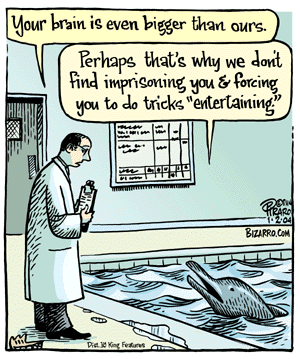
ANOTHER GREAT ANTI FUR BIZARRO Today's Bizarro comic (Sunday, January 11) is another delightful animal rights comment: They say "you can't take it with you," but guess what - the animals and I decided to let you keep all those furs you own. I have pasted it above but for those who only receive text in their emails: We see a picture of hell, hot, flames everywhere. The devil is talking to a woman draped in layers of fur coats; she has sweat pouring off her. He says, "They say 'You can't take it with you' but guess what -- the animals and I decided to let you keep all those furs you owned." Bizarro is a syndicated newspaper cartoon that appears in approximately 200 newspapers around the world. In the US, those papers include the San Francisco Chronicle, Los Angeles Times, Seattle Post-Intelligencer, Dallas Morning News, Miami Herald, Boston Herald, San Diego Union Tribune, Denver Post, Washington Times, Chicago Tribune, Detroit News, St. Paul Pioneer Press, Las Vegas Sun, Cleveland Plain Dealer, Pittsburgh Post Gazette, Nashville Cit Paper, Houston Chronicle, Milwaukee Journal Sentinel. In Canada they include the Vancouver Sun, Toronto Globe and Mail, and the Montreal Gazette. If your paper carries the cartoon, you have a perfect excuse for an anti fur letter to the editor, citing the cartoon, expressing appreciation for the anti-fur sentiment, and perhaps adding some anti-fur facts. PETA has two great fact sheets on fur: Fur Factory Farms: Captive Cruelty --- http://www.peta.org/mc/facts/fswild3.html and Trapping: Pain for Profit -- http://www.peta.org/mc/facts/fswild2.html If you have any trouble finding the correct email address for a letter to the editor, don't hesitate to ask me for help. If your paper does not carry Bizarro, you might want to contact the paper and try to change that. Bizarro is not specifically an animal rights cartoon -- it is a superb, wacky, award winning cartoon, featured in hundreds of papers. But since its creator, Dan Piraro, is an outspoken animal rights activist, it frequently has an animal rights theme. What better way to reach people than with humor? If you go to Piraro's website, http://www.bizarro.com/ and click on "Animal Stuff" you are in for a treat. You'll find a short essay, "Why I'm Vegan," another headed, "Are Humans Carnivores?" some great quotes, and....LOTS OF ANIMAL FRIENDLY CARTOONS that have appeared in papers all over the world! Check it out.
MASS SLAUGHTER OF CIVET CATS TO CONTROL SARS Having removed
a previous ban on the live market sale of exotic animals such
as civet cats, the Chinese Government, in response to a new outbreak of
SARS, has started exterminating animals. The story is on the front page
of the Thursday, January 8, International Herald Tribune, headed, "SARS
disrupts unsavory trade; A low-profit day at animal market." New
York Times writer, Jim Yardley, opens with a description of general conditions
at the Xinyuan market: She quotes Dr. Wolfgang Preiser who has conducted SARS analysis for the World Health Organization, who says that by slaughtering the civets, "they are literally destroying the evidence." A World Health
Organization spokesman, Ian Simpson, says: ""We haven't seen
any evidence that demonstrates conclusively that the virus originates
in civets. Our belief is that the scientific evidence isn't sufficient
to justify a cull of civets." You can read
it on line at:
http://www.factoryfarming.org/gallery/hens7.htm
And your local paper will also no doubt be carrying stories on SARS which may mention the animal slaughter. Don't hesitate to ask me for help if you have any difficulty finding the correct address to email a letter to the editor. Always include your full name, address, and daytime phone number when sending a letter to the editor. Shorter letters are more likely to be published.
NEW YEAR BEGINS WITH BAN ON DOWNED ANIMALS FOR FOOD As expected, mad cow disease has dominated the news over the holiday period. I was pleased to find at least a dozen letters in major papers discussing the cruelty of the meat industry and recommending a switch to a plant based diet. I will paste one at the end of this alert. I was surprised to see a quote from a vegetarian advocate cautioning vegetarians from "using mad cow disease as a recruiting tool." True, trying to persuade a person to go vegan based on fear of the disease is unlikely to have useful long-term effects. That person will surely start eating a different species thought to be free of the disease, and return to eating cows if the beef supply is ruled safe by the authorities. And though I support almost all tactics aimed at persuading people to stop supporting the animal cruelty inherent in the meat and dairy industry, I am not convinced that human health is necessarily the best argument. Is it not safe to assume that Carrie Bradshaw knows she is likely to die of lung cancer? Yet still we have seen her smoke countless cigarettes on Sunday nights on HBO. I don't know that the threat of mad cow disease will have any more effect than the threat of lung cancer, once the hysteria dies down. That doesn't mean we cannot use the disease, indirectly, as a recruiting tool. The letters to the editor section is one of the best read sections of most newspapers. And it generally only carries letters about current stories. A letter about farmed animal cruelty, sent out of the blue, unrelated to any story in the paper, is unlikely to get published. However, though it is little mentioned in the mainstream articles about mad cow disease, animal cruelty is highly relevant to this story. Animal welfare advocates have been trying to get the slaughter of downed animals banned for years. In an op-ed appearing in the Baltimore Sun (Consequences of Cruelty, Dec 31, pg 13A), and many other papers, HSUS's Wayne Pacelle writes, "The coarse handling of downers is one of the cruelest aspects of industrial agriculture. When sick animals collapse in the livestock trucks or the holding pens on the way to slaughter, they are routinely beaten, shocked, dragged with chains or pushed with bulldozers. Those that don't pass visual inspection by federal authorities at slaughterhouses become living garbage, condemned to expire slowly and painfully, alone or on a dead pile." (You can read the whole op-ed at: or in the Chicago Tribune at http://www.chicagotribune.com/news/opinion/oped/chi-0312250101dec25,1,3510101.story or in Newsday at: http://www.newsday.com/news/health/ny-vppac293603445dec29,0,5683106.story?coll=ny-health-headlines or the Hartford Courant at:http://www.ctnow.com/news/opinion/op_ed/hc-madcow0102.artjan02,1,2588268.story?coll=hc-headlines-oped) But there is money in the slaughter of downed cows, and the meat industry managed to defeat legislation banning the practice even after the legislation had been approved by the House and the Senate. If the legislation animal protection groups have been proposing for years had been approved, a downed cow, with BSE, would not have been slaughtered on December 9 and entered the American food system. We can write letters pointing that out, and recommending that people give up eating meat, not because they are frightened of contracting BSE, but because the meat industry is cruel, and vegetarianism is a great choice. Now topical, because of the discovery of mad cow disease in a cruelly slaughtered downed cow, such letters are likely to get published. Also topical, are letters making it clear that shunning beef but eating dairy is no way to avoid supporting the cruelty of the meat industry; many Americans were surprised to learn that a dairy cow had ended up in the meat supply. The slaughter of downed cows for human consumption has now been banned. Those pushing for the ban are pleased with the development, however, since it is based on human health rather than cruelty concerns, celebration may be premature. If downed cows can still be dragged to slaughter so that their bodies may be used for purposes other than human food (leather for example) the new law will not help the animals. So we can also write letters reminding people it is preferable to live in an ethical society, where the slaughter (rather than painless euthanization) of downed animals should be banned regardless of the intended distribution of body parts. Those letters might also still remind people that choosing a lifestyle that contributes to no slaughter is the kindest choice. A large proportion of letters sent to small and medium sized papers are published. And large papers will always publish a letter or two on a topic about which they receive many. So please write. And please ask me for help if you have any trouble finding the correct email address for letters to the editor on your paper's website. Taking a quick look at some of the major stories on the issue: The Monday, January 5, New York Times has a huge front page story headed, "Mad Cow Forces Beef Industry to Change Course, " by Michael Moss, Richard A. Oppel Jr. and Simon Romero. It opens, "The financial motive that drove the industry to defend practices like selling downers has been turned on its head by the discovery of mad cow disease. Now, in an attempt to rescue the market for American beef, the industry is being forced to accept regulation it has long fought." It discusses the financial incentives for slaughtering downed cows. It also mentions another danger to human health: "advanced recovery systems" which use "hydraulic pressure to force extra pounds off cow carcasses, producing filler for processed foods like hamburger, hot dogs and pizza toppings." We read, "Consumer groups initially complained that bone was getting into the advanced meat recovery product and argued that the product should not be labeled as beef. Then, in 1997, federal agriculture officials announced that they had found spinal cord tissue in some of the meat. Concerned that the nerve tissue could increase the public's risk of contracting mad cow disease, consumer groups asked the government to ban the technology, said Linda Golodner, president of the National Consumers League. But both the industry and government regulators resisted, arguing that the absence of the disease in the United States showed that there was no problem." You can read the whole article on line at: http://www.nytimes.com/2004/01/05/opinion/05MON3.html The Monday, January 5, New York Times also includes an unusual op-ed on the issue, which, more than any major media story I have seen, discusses the suffering of dairy cows. The story, by Verlyn Klinkenborg, is headed "Holstein Dairy Cows and the Inefficient Efficiencies of Modern Farming." It spells out the beef/dairy connection: "There was nothing anomalous in that Holstein's slaughter. Beef cattle and dairy cattle represent two different types of animal, but their fates are identical. What most Americans do not realize is that nearly every dairy cow eventually becomes either hamburger or the cheaper variety of steak when her profitability drops." We learn
about the dairy cow's life: "After
poultry and pigs, the dairy industry has become one of the most concentrated
forms of agriculture in America. The old mental picture of a herd of Holsteins
standing hock-deep in pasture bears no relation to the way milk is produced
in much of America. Some herds, especially in the West and Southwest,
number in the thousands, which means the animals spend their lives in
barns on cement where they are milked automatically, in some cases on
huge rotating platforms that look like something out of science fiction. You can read
the whole piece on line at: The New York Times (January 2) and the Minneapolis Star Tribune (January 5) ran an op-ed piece by Eric Schlosser, author of the best-seller, "Fast Food Nation." He
writes of the USDA: "Right now you'd have a hard time finding a federal
agency more completely dominated by the industry it was created to regulate." He
gives details of the unfortunate connections, and writes, "The Agriculture
Department has a dual, often contradictory mandate: to promote the
sale of meat on behalf of American producers and to guarantee that American
meat is safe on behalf of consumers." You can read the whole piece on line at: http://www.nytimes.com/2004/01/02/opinion/02SCHL.html or http://www.startribune.com/stories/1519/4302387.html And finally, while there is much misinformation coming from the press about prions and the virtual impossibility of contracting the disease, The Wall Street Journal covered the issue responsibly in an article, by Antonio Regalado, headed "Scientific Data Offer No Proof Of Beef Safety" (Dec 29. pg B1) It tells us, "Steaks and hamburgers made from beef muscle haven't been shown to be dangerous, but some leading experts in Europe and the U.S. say the risks of meat from sick cattle remain unknown, and new studies have implicated muscles in other species." (I thank Lew Regenstein for making sure we knew about the article.) Wall Street Journal articles are not available on line to non subscribers, however, there is a thorough article on the issue, by Dr Michael Greger, which you will find at: http://organicconsumers.org/madcow/Greger122403.cfm Greger tells us, "It is unconscionable that the USDA and the beef industry continue to insist that the deadly prions aren't found in muscle meat." Unconscionable, but when one takes into account Schlosser's information, hardly surprising. Mad cow disease will continue to be in every paper for some time to come. I will close, urging activists to take this opportunity to write letters discussing the cruelty of the meat and dairy industries, and to recommend dietary changes that avoid supporting the cruelty. Below, I will paste a letter to the editor from activist Syd Baumel, who does it beautifully: The Vancouver Province (British Columbia), January 5, Editorial; Pg. A15 'Spare a thought for the cows' In our preoccupation with making beef safe for people, let's spare a moment to think about making beef safe for Canadian cows. Most beef and dairy today is produced within a ruthlessly competitive industrial farming system that reduces sensitive animals to production units, decimates small farms and rural communities, squanders land, fresh water and energy to fatten nearly a billion reluctant animals for slaughter every year in Canada alone. These factory farms or CAFOs (Concentrated Animal Feeding Operations) and the laxly regulated animal transport and slaughter industry that serves them have become the new mills of industry, exposed and denounced by everyone from ecologists to environmentalists to clergy and media such as the New York Times. Several years ago, the Humane Society of the United States wrote a simple prescription for consumers who don't want to swallow this morally unpalatable new agriculture: reduce, refine and replace. Reduce means eat fewer animal foods. Refine means eat more humanely and sustainably produced animal foods (such as those certified by local and national humane societies). And replace meat with a veggie burger, a curried lentil dish or a bowl of soy ice cream instead of a pork chop, a hot dog or a milkshake. It's a prescription that challenges and empowers people to at least "go humane" if not vegetarian. As Canada's beef industry teeters on the brink of failure and a rapidly growing ethical consumer movement strives to put conscience back into the kitchen, a timely, morally principled and government-supported transition to a humane and sustainable new Canadian agriculture could be a life raft for us all. It's time we put culture back into agriculture. Syd Baumel, Winnipeg ----- Syd's letter is beautiful, however, shorter, less eloquent letters, appealing to the ethical sense or mercy in readers, are just as likely to be published and to have a positive impact. In fact, short letters are more likely to be published. Always include your full name, address, and daytime phone number when sending a letter to the editor. |